Weather Alerts For Carp Lake, MI
Heat Advisory
-# HEADLINE -------------------- HEAT ADVISORY REMAINS IN EFFECT UNTIL 8 PM EDT THURSDAY # DETAILS -------------------- WHAT Heat index values up to 101 expected. WHERE Portions of Eastern Upper and Northern Lower Michigan. WHEN Until 8 PM EDT Thursday. IMPACTS Hot temperatures and high humidity may cause heat illnesses. ADDITIONAL DETAILS Prolonged high humidity and limited overnight cooling will lead to compounding heat stress throughout the week. ISSUED AT Wednesday, July 1, 2026 at 1:19 AM EDT ISSUED BY National Weather Service Gaylord MI HEADER URGENT - WEATHER MESSAGE # PRECAUTIONARY/PREPAREDNESS ACTIONS -------------------- Drink plenty of fluids, stay in an air-conditioned room, stay out of the sun, and check up on relatives and neighbors. Take extra precautions when outside. Wear lightweight and loose fitting clothing. Try to limit strenuous activities to early morning or evening. Take action when you see symptoms of heat exhaustion and heat stroke. To reduce risk during outdoor work, the Occupational Safety and Health Administration recommends scheduling frequent rest breaks in shaded or air conditioned environments. Anyone overcome by heat should be moved to a cool and shaded location. Heat stroke is an emergency! Call 9 1 1. # AREAS AFFECTED -------------------- Charlevoix, Crawford, Antrim, Beaver Island and surrounding islands, Benzie, Emmet, Grand Traverse, Kalkaska, Leelanau, Mackinac Island/Bois Blanc Island, Manistee, Missaukee, Otsego, Roscommon, Wexford
Severe Storm Risk
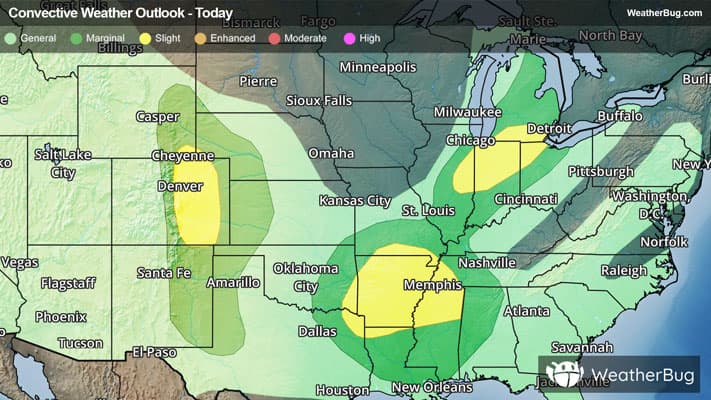
-There is a Marginal Severe Storm Risk for your location. Continue reading for today's outlook from the National Weather Service's Storm Prediction Center. -------------------- National Severe Storm Outlook THERE IS AN ENHANCED RISK OF SEVERE THUNDERSTORMS ACROSS PARTS OF WESTERN KANSAS SUMMARY Scattered severe thunderstorms will continue across parts of the central High Plains, with severe wind gusts being the primary hazard. Other severe thunderstorms are still possible across the Great Lakes and Northeast, as well as broader parts of the central Plains to middle Missouri Valley. Central Plains into the Upper MS Valley Between a broad large-scale trough over the West and an expansive upper ridge over the eastern half of the CONUS, a belt of enhanced midlevel southwesterly flow is yielding around 40-50 kt of effective shear from the central Plains into the upper MS Valley. Here, middle/upper 60s to lower 70s dewpoints beneath steep midlevel lapse rates (sampled by 00Z observed soundings) are contributing to moderate-strong surface-based buoyancy. Despite gradual nocturnal boundary-layer cooling, this buoyancy and deep-layer shear will continue to promote the development of loosely organized convective clusters and supercell structures spreading northeastward overnight. The primary concern with this activity will be damaging/severe wind gusts (some upwards of 75 mph) and large hail. Northeast A band of thunderstorms tracking southeastward across southern Ontario could spread into parts of NY tonight, and given an established cold pool, damaging winds will be possible. However, surface observations and the 00Z ALB sounding suggest lingering low-level static stability in the wake of earlier convection may limit the overall severe risk.