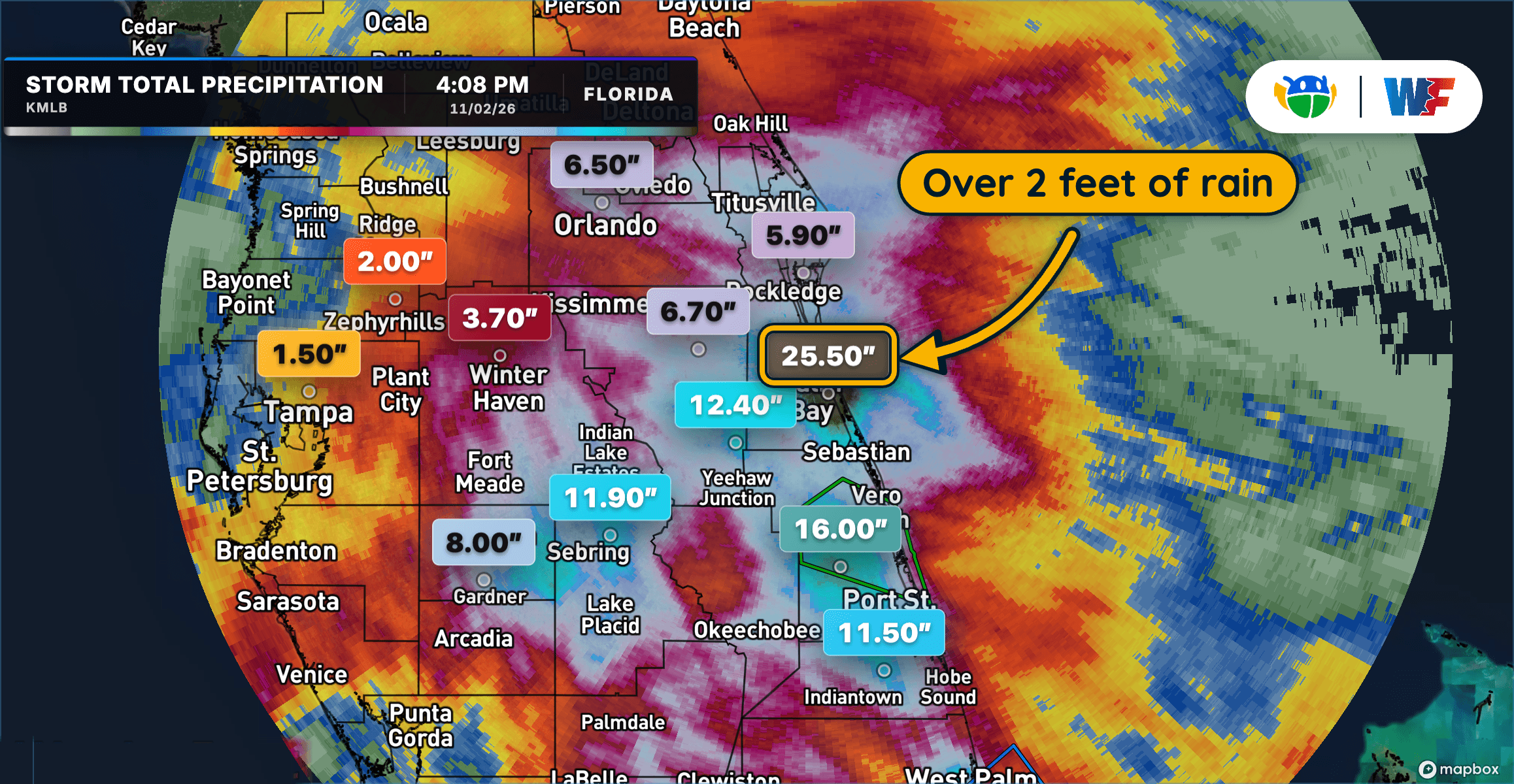
Extreme Rainfall Triggers Dangerous Flooding Across Central and East Florida
Extreme Rainfall Triggers Dangerous Flooding Across Central and East Florida
Read More
# HEADLINE -------------------- The Flood Warning is extended for the following rivers in Louisiana FLOOD WARNING NOW IN EFFECT UNTIL LATE FRIDAY NIGHT # SUMMARY -------------------- Calcasieu River near White Oak Park affecting Calcasieu Parish. For the Calcasieu River...including Glenmora, Oakdale, Oberlin, Kinder, White Oak Park, Salt Water Barrier...Minor flooding is forecast. # DETAILS -------------------- WHAT Minor flooding is occurring and minor flooding is forecast. WHERE Calcasieu River near White Oak Park. WHEN Until late Friday night. IMPACTS At 2.0 feet, Minor flooding of Goos Ferry Road will occur. ADDITIONAL DETAILS - At 8:35 AM CST Tuesday the stage was 2.2 feet. - RECENT ACTIVITY The maximum river stage in the 24 hours ending at 8:35 AM CST Tuesday was 2.2 feet. - FORECAST - The river will oscillate around flood stage with a maximum value of 2.1 feet tomorrow morning. - Flood stage is 2.0 feet. - http://www.weather.gov/safety/flood ISSUED AT Tuesday, November 3, 2026 at 9:06 AM CST ISSUED BY National Weather Service Lake Charles LA HEADER Flood Statement # PRECAUTIONARY/PREPAREDNESS ACTIONS -------------------- Turn around, don't drown when encountering flooded roads. Most flood deaths occur in vehicles. Motorists should not attempt to drive around barricades or drive cars through flooded areas. Additional information is available at www.weather.gov.
There is a Marginal Severe Storm Risk for your location. Continue reading for today's outlook from the National Weather Service's Storm Prediction Center. -------------------- National Severe Storm Outlook THERE IS A MARGINAL RISK OF SEVERE THUNDERSTORMS FROM THE MID TO LOWER MISSISSIPPI RIVER VALLEY AND INTO EAST TEXAS SUMMARY Thunderstorms with potential for isolated severe wind gusts and perhaps a brief tornado or two will be possible today from the Sabine and Lower Mississippi Valleys northward into the Mid Mississippi Valley. Synopsis 11 UTC surface analysis reveals a pair of cyclones over the northern and central Plains. An attendant cold front is noted pushing southeast across the Plains with a weaker front/surface trough arcing from eastern KS southward into southern TX. Ahead of this surface trough, modest moisture return continues with low to mid 60s dewpoints spreading northward through the MS Valley. The southern cyclone, analyzed over eastern KS, will continue to intensify as it drifts northeast in tandem with a prominent upper wave, likely reaching the upper MS Valley by late tonight. The primary synoptic cold front is forecast to overtake the surface trough by mid-afternoon across central MO, AR, and LA as the surface low lifts to the northeast. Thunderstorm potential should increase as this occurs, and a few strong to severe thunderstorms appear possible given a favorable kinematic environment. Lower Mississippi Valley to Eastern Texas Thunderstorms ongoing this morning will continue to weaken through mid-day with some degree of re-intensification and/or redevelopment likely by mid to late afternoon owing to a combination of strengthening forcing for ascent associated with the approaching cold front and modest diurnal heating/destabilization. The degree of re-intensification remains somewhat uncertain due extensive cloud cover and warm mid-level temperatures sampled by regional 12z soundings. Additionally, limited cooling aloft is expected as the primary upper wave (an any attendant ascent-related cooling) lifts to the north. Consequently, forecast guidance generally depicts meager buoyancy profiles featuring 500-1000 J/kg MLCAPE that will favor anemic convection. Mean flow through the CAPE-bearing layer should generally be aligned with the cold front, which will maintain a predominantly linear/broken-band storm mode. Both of these factors should modulate the overall potential for widespread intense convection. Nonetheless, strong (40-50 knot) deep-layer wind shear and veering through the lowest kilometer will still promote some degree of organization of the deeper, more intense cells and line segments, and could support isolated severe gusts and perhaps brief tornadoes. This potential appears greatest across eastern AR and into northern LA on the northern fringe of a plume of higher low-level moisture where the overlap of ascent, strong shear, and buoyancy will be maximized. Mid MS Valley Very strong low-level shear will persist through this afternoon and evening ahead of the deepening surface low across MO, IA, and IL. Forecast soundings across this region depict 0-1 km SRH values on the order of 250-300 m2/s2, and mid-level flow will likely exceed 50 knots as the upper jet shifts east/northeast. Despite a favorably sheared environment, poor lapse rates and greater displacement from richer low-level moisture will limit buoyancy profiles - especially for parcels near the surface. This casts considerable uncertainty on the propensity for strong/severe thunderstorms, though the strong kinematics may compensate for the meager thermodynamics and could support a localized and transient severe wind, and perhaps tornado, threat.
Extreme Rainfall Triggers Dangerous Flooding Across Central and East Florida