Weather Alerts For Mount Leonard, MO
Flood Watch
-# HEADLINE -------------------- FLOOD WATCH REMAINS IN EFFECT THROUGH FRIDAY MORNING # DETAILS -------------------- WHAT Flooding caused by excessive rainfall continues to be possible. WHERE Portions of Kansas, including the following areas, Johnson KS, Leavenworth, Linn KS, Miami and Wyandotte and Missouri, including the following areas, Bates, Cass, Clay, Cooper, Henry, Howard, Jackson, Johnson MO, Lafayette, Pettis, Platte and Saline. WHEN Through Friday morning. IMPACTS Excessive runoff may result in flooding of rivers, creeks, streams, and other low-lying and flood-prone locations. ADDITIONAL DETAILS - A very moist airmass in place will bring the potential for high rainfall rates and flooding with any thunderstorms. - http://www.weather.gov/safety/flood ISSUED AT Thursday, June 25, 2026 at 11:53 AM CDT ISSUED BY National Weather Service Kansas City/Pleasant Hill MO HEADER URGENT - IMMEDIATE BROADCAST REQUESTED | Flood Watch # PRECAUTIONARY/PREPAREDNESS ACTIONS -------------------- You should monitor later forecasts and be alert for possible Flood Warnings. Those living in areas prone to flooding should be prepared to take action should flooding develop. # AREAS AFFECTED -------------------- Bates, Jackson, Cass, Clay, Cooper, Henry, Howard, Johnson KS, Johnson MO, Lafayette, Leavenworth, Linn KS, Miami, Pettis, Platte, Saline, Wyandotte Including the cities of Marshall, Riverside, Rich Hill, Independence, Paola, Sedalia, Mound City, Lexington, Raymore, Liberty, Lenexa, Odessa, La Cygne, Parkville, Osawatomie, Clinton, Gladstone, Fort Leavenworth, Overland Park, Pleasant Hill, Platte City, Boonville, Belton, Warrensburg, Pleasanton, Weston, Kearney, Glasgow, Harrisonville, Stanley, Kansas City Kansas, Weatherby Lake, Butler, Windsor, Excelsior Springs, Louisburg, Concordia, Olathe, New Franklin, Leavenworth, Kansas City, Lansing, Higginsville, Fayette, Shawnee, and Adrian
Lightning Alert
-Closest strike: 6.7 miles Stay Alert! Remain in a safe area until there has been no lightning within 10 miles of this location for 30 minutes. Please be aware that lightning activity can remain high even when a storm is moving away from your location. Even if rain has stopped, do not leave your safe area until WeatherBug indicates that lightning is more than 10 miles away from this selected location. IF OUTDOORS Avoid water, high ground, and open spaces. Avoid all metal objects including electric wires, fences, and machinery. Find a safe area in a building or in a fully enclosed vehicle with the windows completely shut. Unsafe places include underneath canopies, small picnic or rain shelters, convertibles, or near trees. IF INDOORS Avoid water and stay away from doors and windows. Avoid using a hard line telephone. Take off headphones. Turn off, unplug, and stay away from appliances, computers, power tools, and TV sets. Lightning may strike exterior electric and phone lines, inducing shocks to inside equipment.
Severe Storm Risk
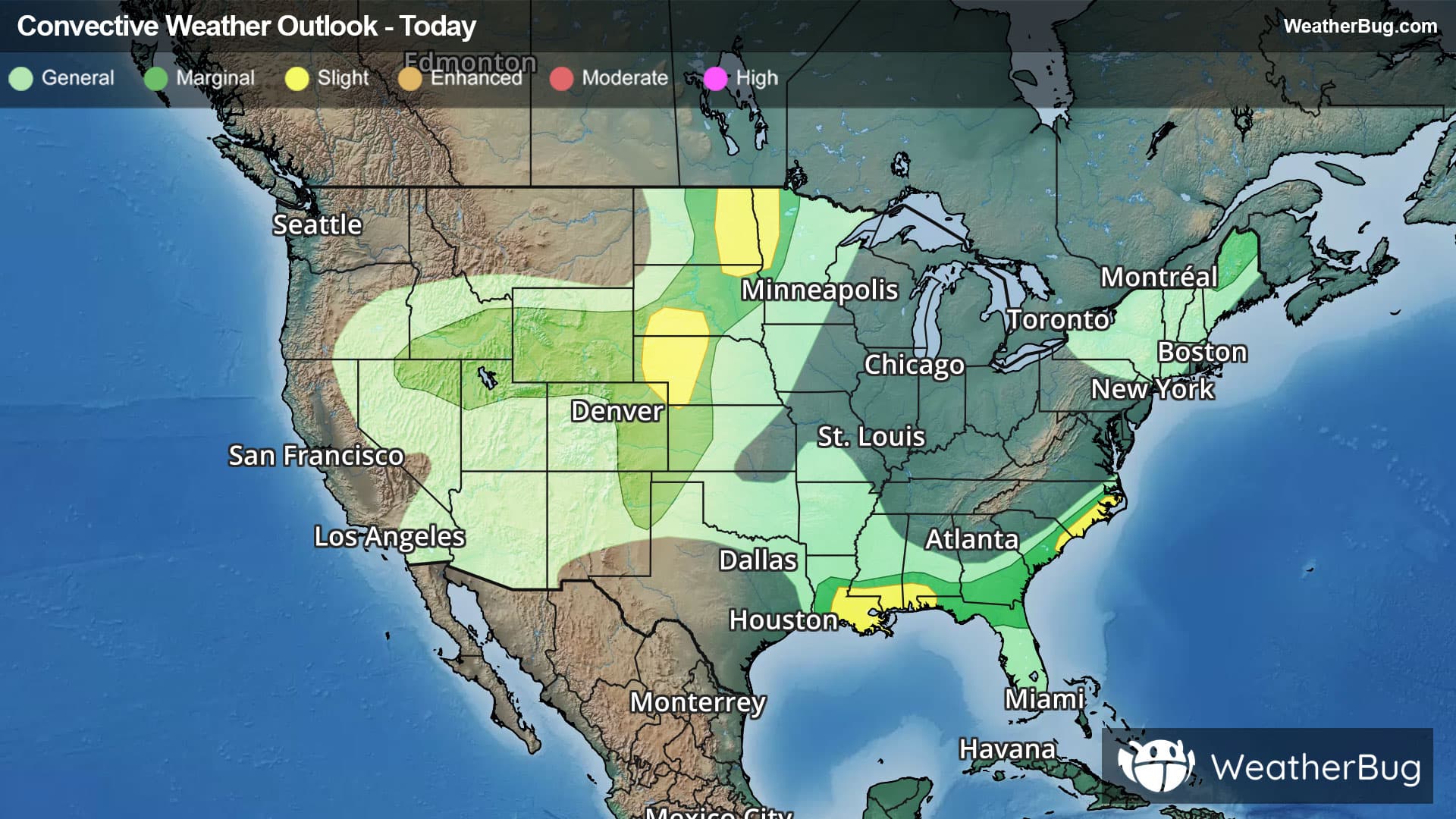
-There is a Marginal Severe Storm Risk for your location. Continue reading for today's outlook from the National Weather Service's Storm Prediction Center. -------------------- National Severe Storm Outlook THERE IS A SLIGHT RISK OF SEVERE THUNDERSTORMS ACROSS THE CENTRAL/SOUTHERN PLAINS TO OZARKS...WYOMING...AND UPPER OHIO VALLEY SUMMARY Scattered severe thunderstorms are expected through this evening across parts of the southern/central Plains, with large hail and severe/damaging winds possible. A more focused corridor of tornado potential may exist this afternoon/evening across northern Oklahoma and southern Kansas, where a strong tornado may occur. Southern/Central Plains and Ozarks Strong convection continues at midday across south-central Kansas into northern Oklahoma, augmenting a front that will continue to settle south-southeastward toward the Texas Panhandle and western Oklahoma by this evening. Some of this convection has been organized/bowing on a small scale this morning and some diurnal intensification could occur through peak heating as it progresses southeastward, but the continued influence of proximal rain-cooled air casts some uncertainty regarding intensity/peak risk timing. The most likely scenario will be for the possibility of deeper convective development later this afternoon on the west-southwest flank of these lingering early day storms, where outflow modifies/intercepts the surface front, and in north and east proximity to a Panhandles surface low. Additional post-frontal low-level upslope flow-related potentially severe storms are also expected across southeast Colorado near the Front Range southeastward into the Panhandle beginning mid/late afternoon. This anticipated development later today is expected to be focused in a narrow corridor of moderate to strong instability from southeast Colorado east-southeastward into far southern Kansas and northern Oklahoma. With strong deep-layer shear expected, initial supercells should pose a threat for large hail, severe wind gusts and potentially a tornado risk. But, convective mode will probably tend to become mixed/messy quickly, as thunderstorms interact/merge with each other. Low-level shear is forecast to markedly increase near the surface boundary later today as a southerly low-level jet strengthens. Resultant elongated/curved hodographs support the potential for tornadoes, especially with any thunderstorms that can remain at least semi-discrete. And given the enhanced effective SRH near the boundary, a strong tornado appears possible if a supercell mode can be maintained. Higher-based convection will develop farther south into the southern High Plains this afternoon, where a more deeply mixed airmass suggests a greater threat for scattered severe/damaging winds. But, some hail could also occur with the stronger cores. This activity should tend to cluster and spread east-southeastward across northwest Texas, the Oklahoma/Texas Panhandles, and eventually into western Oklahoma this evening, while continuing to pose mainly a severe wind threat before eventually weakening. Mid Mississippi Valley into the Ohio Valley and New York 50-60 kt mid-level westerly flow will spread eastward across the Midwest/Ohio Valley into the central Appalachians through this evening as an upper-level trough moves eastward over the Great Lakes. A weak surface low should also develop eastward over the lower Great Lakes, with a cold front advancing east-southeastward across the Midwest/Ohio Valley. Surface dewpoints generally range in the 50s to low 60s F ahead of the front. Coupled with poor mid lapse rates aloft and ongoing cloudiness, instability that develops by this afternoon may tend to remain somewhat limited. Even so, strong deep-layer shear associated with the mid-level jet will aid in updraft organization, with a mix of multicell clusters and possibly some marginal supercell structures developing this afternoon along/ahead of the front. Isolated severe hail and damaging winds both appear possible, and a tornado or two may also occur across parts of Ohio into western/central Pennsylvania and western New York where slightly stronger low-level flow and related shear should exist. A somewhat higher/more focused severe potential appears to exist across central/eastern Ohio into western Pennsylvania from mid-afternoon through early evening. Utah/Wyoming/Montana and far eastern Idaho Similar to yesterday, fairly high-based showers and thunderstorms should develop this afternoon across the eastern Great Basin. With a well-mixed boundary layer forecast with daytime heating, the main threat with most of this activity should be isolated severe winds with outflow-dominant convection as it spreads from Utah into Wyoming this afternoon and evening. Have introduced a wind-related categorical Slight risk for the potential of semi-organized storms as a mid-level speed max interfaces with an unstable/well-mixed boundary layer across Wyoming. Otherwise, occasional hail may also exist farther north in southeast Idaho, Wyoming, and parts of Montana, where cooler temperatures aloft, stronger mid-level flow/deep-layer shear, and pockets of greater instability should support more robust convection.