Weather Alerts For Somerset, NY
Beach Hazard Statement
-# HEADLINE -------------------- BEACH HAZARDS STATEMENT IN EFFECT THROUGH SATURDAY MORNING # DETAILS -------------------- WHAT Strong currents and dangerous swimming conditions expected. WHERE Beaches of Niagara and Orleans counties. WHEN Through Saturday morning. IMPACTS Strong currents and dangerous swimming conditions. ISSUED AT Thursday, June 18, 2026 at 3:57 AM EDT ISSUED BY National Weather Service Buffalo NY HEADER Lakeshore Hazard Message # PRECAUTIONARY/PREPAREDNESS ACTIONS -------------------- Stay out of the water to avoid dangerous swimming conditions. # AREAS AFFECTED -------------------- Niagara, Orleans
High Wind Warning
-# HEADLINE -------------------- HIGH WIND WARNING IN EFFECT UNTIL 8 PM EDT THIS EVENING # DETAILS -------------------- WHAT Southwest winds 20 to 30 mph with gusts up to 55 mph expected. WHERE Erie, Niagara, Orleans, Monroe, Genesee, Wyoming, Livingston, Ontario, and Chautauqua Counties. WHEN Until 8 PM EDT this evening. IMPACTS Strong winds will blow down trees and power lines. Scattered power outages are expected. Travel will be difficult, especially for high profile vehicles. ADDITIONAL DETAILS Fully leafed out trees will result in more tree damage than with similar wind speeds during the colder months of the year. ISSUED AT Thursday, June 18, 2026 at 12:47 AM EDT ISSUED BY National Weather Service Buffalo NY HEADER URGENT - WEATHER MESSAGE # PRECAUTIONARY/PREPAREDNESS ACTIONS -------------------- Avoid being outside in forested areas and around trees. If possible, remain in the lower levels of your home during the windstorm, and avoid windows. Use caution if you must drive. # AREAS AFFECTED -------------------- Ontario, Chautauqua, Genesee, Livingston, Monroe, Niagara, Northern Erie, Orleans, Southern Erie, Wyoming Including the cities of Niagara Falls, Medina, Rochester, Buffalo, Batavia, Warsaw, Geneseo, Canandaigua, Jamestown, Orchard Park, and Springville
Lightning Alert
-Closest strike: 5.23 miles Stay Alert! Remain in a safe area until there has been no lightning within 10 miles of this location for 30 minutes. Please be aware that lightning activity can remain high even when a storm is moving away from your location. Even if rain has stopped, do not leave your safe area until WeatherBug indicates that lightning is more than 10 miles away from this selected location. IF OUTDOORS Avoid water, high ground, and open spaces. Avoid all metal objects including electric wires, fences, and machinery. Find a safe area in a building or in a fully enclosed vehicle with the windows completely shut. Unsafe places include underneath canopies, small picnic or rain shelters, convertibles, or near trees. IF INDOORS Avoid water and stay away from doors and windows. Avoid using a hard line telephone. Take off headphones. Turn off, unplug, and stay away from appliances, computers, power tools, and TV sets. Lightning may strike exterior electric and phone lines, inducing shocks to inside equipment.
Severe Storm Risk
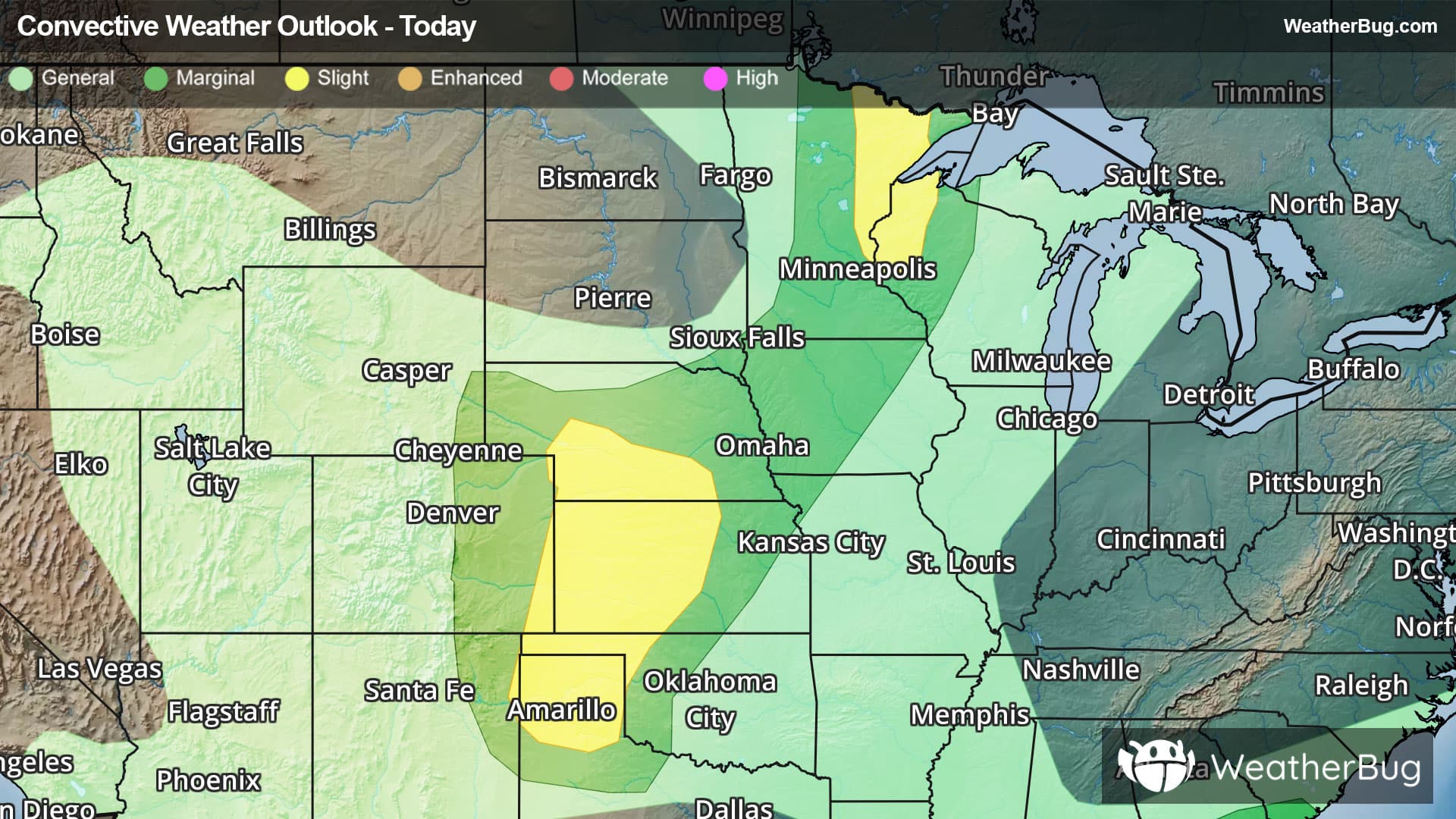
-There is a Marginal Severe Storm Risk for your location. Continue reading for today's outlook from the National Weather Service's Storm Prediction Center. -------------------- National Severe Storm Outlook THERE IS A SLIGHT RISK OF SEVERE THUNDERSTORMS ACROSS THE GULF COAST AND CENTRAL APPALACHIANS TO MID-ATLANTIC/NORTHEAST SUMMARY Isolated to scattered severe thunderstorms are expected from Kentucky and the central Appalachians to the Mid-Atlantic, with primarily damaging wind gusts or marginal hail. Scattered severe storms are possible from upstate New York into New England, with damaging wind gusts and tornado potential. A few tornadoes may also occur over parts of the middle Gulf Coast states, and scattered storms may produce gusty winds or marginal hail from Oklahoma into western North Texas. Central Appalachians to Mid-Atlantic/North Carolina The region will be influenced by lingering long-lived overnight-upscale-transitioning linear segments that moved across Kentucky/West Virginia, that will likely continue to pose a severe risk early today, mainly in the form of damaging winds. This may be even as updraft/storm intensities somewhat trend downward over the mountains. Even if weakening occurs early today east of the Appalachians spine, residual outflow/differential heating and potential MCV influences should help focus redevelopment/re-intensification into the Piedmont later today, with additional development westward toward the Cumberland Plateau along the residual convective boundary as well as the east/southeastward-advancing front. Moderate diurnal destabilization aside, organized severe potential will be aided by seasonally strong winds through the low/mid-troposphere, even with a tendency for low-level winds to weaken into this afternoon. Northeast States Within a broader area of cyclonic flow aloft, a leading shortwave trough will move from the Lower Great Lakes into the Northeast, with a 90 kt mid-level speed max and cooling aloft moving across New York and parts of New England during the day. Low pressure will develop into southern Quebec, with a cold front extending southward into the region. Surface heating and gusty south winds will bring 60s F dewpoints into the area with up to 1000 J/kg MUCAPE expected. Relatively warm profiles will develop near 300 mb, somewhat limiting storm depth. However, ample mid-level cooling will still support sufficient destabilization and the development of intensifying low-topped storms into the afternoon. Pronounced deep-layer/low-level shear and backed surface winds ahead of the cold front will favor low-topped supercells. Cells should develop/further increase over northern New York through midday/early afternoon and will move quickly east. Damaging winds, a couple of tornadoes, and hail will all be possible, although smaller hail may be more likely given the low EL heights. Gulf Coast including parts of LA/MS/AL/GA/FL Already strong mid/low-level winds across southeast Louisiana and southern Mississippi, associated with the remnants of Arthur, will further increase and spread east-northeastward across Alabama and Florida Panhandle toward Georgia, as a weak surface low and mid-level wave spread northeast regionally. The strong low-level shear and mid 70s F dewpoints will support organized bands of storms with embedded stronger/rotating cells capable of a northeastward-transitioning tornado risk today. Oklahoma/southern Kansas to western North Texas Isolated mostly elevated severe storms capable of hail will remain possible early today across southeast Kansas and northern Oklahoma and possibly southwest Missouri. These storms could linger today and also pose some damaging wind risk. Additional deep convection may develop into late afternoon/early evening within a very unstable environment across western Oklahoma into western North Texas near the southward-shifting front and surface low/dryline across Texas, with isolated large hail and damaging winds possible.