Winds and Hail Fall Across Central U.S.
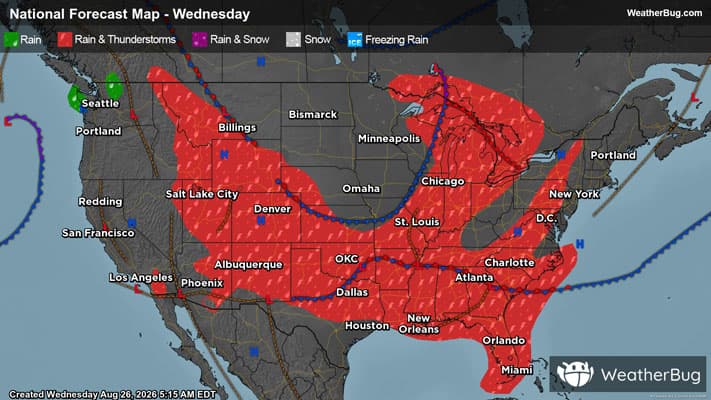
Severe storms will romp again across multiple corners of the central U.S. today.
Read More
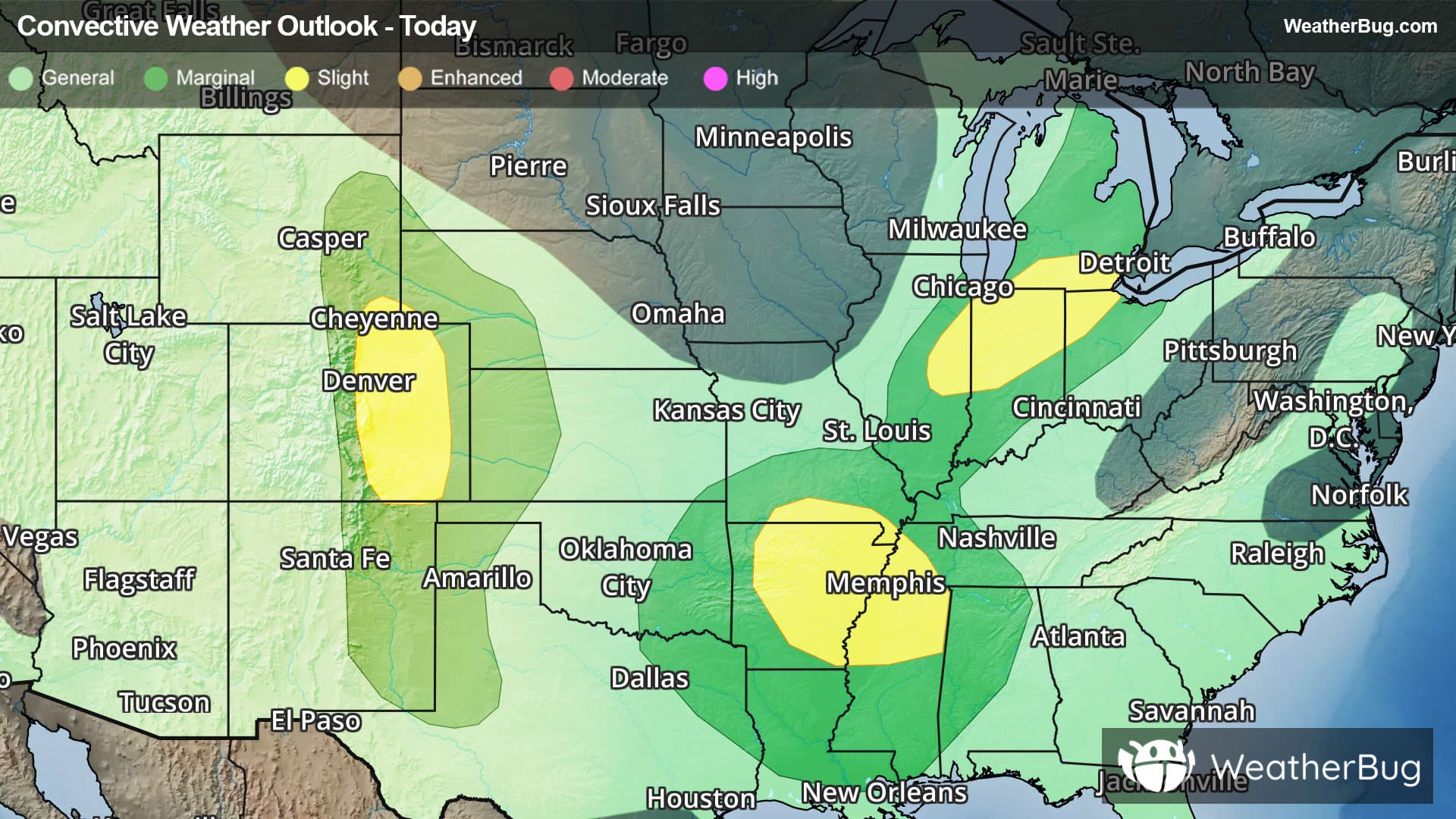
There is a Marginal Severe Storm Risk for your location. Continue reading for today's outlook from the National Weather Service's Storm Prediction Center. -------------------- National Severe Storm Outlook THERE IS A SLIGHT RISK OF SEVERE THUNDERSTORMS ACROSS PARTS OF THE SOUTHERN GREAT LAKES/MIDWEST...CENTRAL HIGH PLAINS...AND OZARKS/MID-SOUTH INTO THE LOWER MISSISSIPPI VALLEY SUMMARY Isolated to widely scattered severe thunderstorms are forecast today across parts of the southern Great Lakes into the Midwest, central/southern High Plains, and the Ozarks into the Mid-South and Lower Mississippi Valley. Severe/damaging winds should be the main threat across these regions, though large hail is also possible, particularly across the central High Plains. Mid-South/TN Valley An MCS continues to push gradually southward/southeastward across western and middle TN. The downstream airmass is heating and destabilizing, but vertical shear remains weak and the overall system has not strengthened notably in the past hour. Destabilization across the region is strongest from the Mid-South into the Lower MS Valley, where dewpoints are largely in the mid 70s. Less low-level moisture is noted from middle TN into northern AL, but airmass destabilization is still anticipated amid modest heating. The general expectation is for the MCS to continue, but with new and/or stronger updrafts likely trending towards the western flank where the buoyancy is greatest. Even then, the lack of stronger vertical shear suggests an outflow-dominant mode with minimal organization. As such, sporadic damaging gusts are possible, particularly via updraft augmentation via storm interactions, but the current magnitude and orientation of the wind probability seems sufficient. Arklatex across much of AR into the Mid-South/Lower MS Valley A somewhat separate area of thunderstorm development is anticipated this afternoon west of what was discussed in the previous paragraph, although some interaction between these two regimes may occur over the Mid-South vicinity. Recent surface observations depict a surface low along the central TX/OK border (in the GYI/DUA vicinity). This low is forecast to progress gradually eastward into a moist and diurnally destabilized airmass from the Arklatex across much of AR and northern LA. A weak MCV, noted in visible satellite imagery, lags behind this surface low, and could augment ascent as it too moves eastward. Low-level convergence on a stalled frontal boundary that extends across central AR as well as along a front approaching northern AR this evening could act as additional mechanisms for thunderstorm initiation. All of these factors will likely result in scattered to numerous thunderstorms across the region. Modest deep-layer shear should support some updraft organization, with multicell clusters likely the dominant mode. High total precipitable water values and large buoyancy will support robust downbursts capable of damaging wind gusts. Strong buoyancy could support occasional hail as well. Clustering may eventually result in several bowing segments this evening. As such, there is potential for at least isolated damaging winds to persist across parts of southern LA/MS. Southern Great Lakes into the Midwest Satellite imagery continues to show a well-defined shortwave trough moving across the Upper Great Lakes. Primary surface low associated with this system is occluded over northwest Ontario, but a secondary triple point low is moving across Upper MI. This system is forecast to move eastward today, with the attendant cold front progressing southeastward. Modest low-level moisture advection and heating ahead of this front will result in a corridor of moderate to strong buoyancy from central IL northeastward into southern Lower MI. Thunderstorm development is anticipated within this corridor this afternoon. Low/mid-level winds will tend to remain fairly modest and veered, but 25-35 kt of deep-layer shear should foster some updraft organization. A mix of multicell clusters and marginal supercells should pose a threat for both hail and damaging winds, with the wind threat potentially becoming the primary risk with eastward extent into the Midwest as thunderstorms grow upscale. Veered low-level flow should keep the tornado potential low. The overall severe threat will likely diminish quickly this evening as convection outpaces the low-level moisture/instability, and nocturnal cooling stabilizes the boundary layer. Central High Plains Low levels across the central High Plains are currently characterized by dewpoints in the upper 50s and low 60s. Modest low-level upslope flow will help maintain this low-level moisture through the afternoon. This moisture combined with diurnal heating and steep mid-level lapse rates will result in airmass destabilization and moderate buoyancy by the late afternoon. Additionally, southern periphery of the enhanced northwesterly flow extending from the northern Plains into the Mid MS Valley will be over the central High Plains, resulting in 25 to 35 kt of effective bulk shear. Late afternoon thunderstorm development is anticipated within this environment, with some isolated supercells possible. Hail will be the primary risk initially, particularly across the CO Foothills. A trend towards clustering and more damaging wind potential is expected as this activity spreads east-southeastward through the evening. Southern High Plains Mid-level flow and related deep-layer shear should be somewhat weaker than areas farther north. Still, convection that develops across central into eastern NM may become loosely organized while posing an isolated threat for severe gusts given the presence of a very well-mixed boundary layer. This threat may continue into parts of the OK/TX Panhandles and west TX through the evening before eventually weakening.
Pollen Index: 10.4 Pollen Level: high Predominant Pollen: Ragweed, Nettle and Hemp. The quantity of pollen grains in the air for Thursday will remain relatively stable in the very high range. No change doesn't mean no pollen, it just means that pollen producing plants are delivering pollen at a steady pace.