Weather Alerts For Mellen, WI
Heat Advisory
-# HEADLINE -------------------- HEAT ADVISORY REMAINS IN EFFECT FROM 9 AM MONDAY TO 7 PM CDT TUESDAY # DETAILS -------------------- WHAT Heat index values of 100 to 105 expected Monday afternoon and 95 to 100 Tuesday afternoon. Monday night heat indices will remain around or above 70 degrees, which will still be hazardous for anyone without shelter after the heat Monday afternoon. WHERE Price, Ashland, Bayfield, Iron, and Sawyer Counties. This includes the Tribal Lands of the northwestern area of the Lac du Flambeau Band, the Red Cliff Band, the Lac Courte Oreilles Reservation and the Bad River Reservation. Other locations including the Apostle Islands National Lakeshore and Madeline Island. WHEN From 9 AM Monday to 7 PM CDT Tuesday. IMPACTS Hot temperatures and high humidity may cause heat illnesses. ISSUED AT Sunday, June 28, 2026 at 11:59 PM CDT ISSUED BY National Weather Service Duluth MN HEADER URGENT - WEATHER MESSAGE # PRECAUTIONARY/PREPAREDNESS ACTIONS -------------------- Drink plenty of fluids, stay in an air-conditioned room, stay out of the sun, and check up on relatives and neighbors. # AREAS AFFECTED -------------------- Ashland, Bayfield, Iron, Price, Sawyer Including the cities of Hurley, Phillips, Hayward, Ashland, Washburn, and Bayfield
Lightning Alert
-Closest strike: 26.84 miles Monitor Storms You are not at immediate risk, but frequently check WeatherBug to see if storms are moving towards you. Be aware that new storms can also form with little notice.
Severe Storm Risk
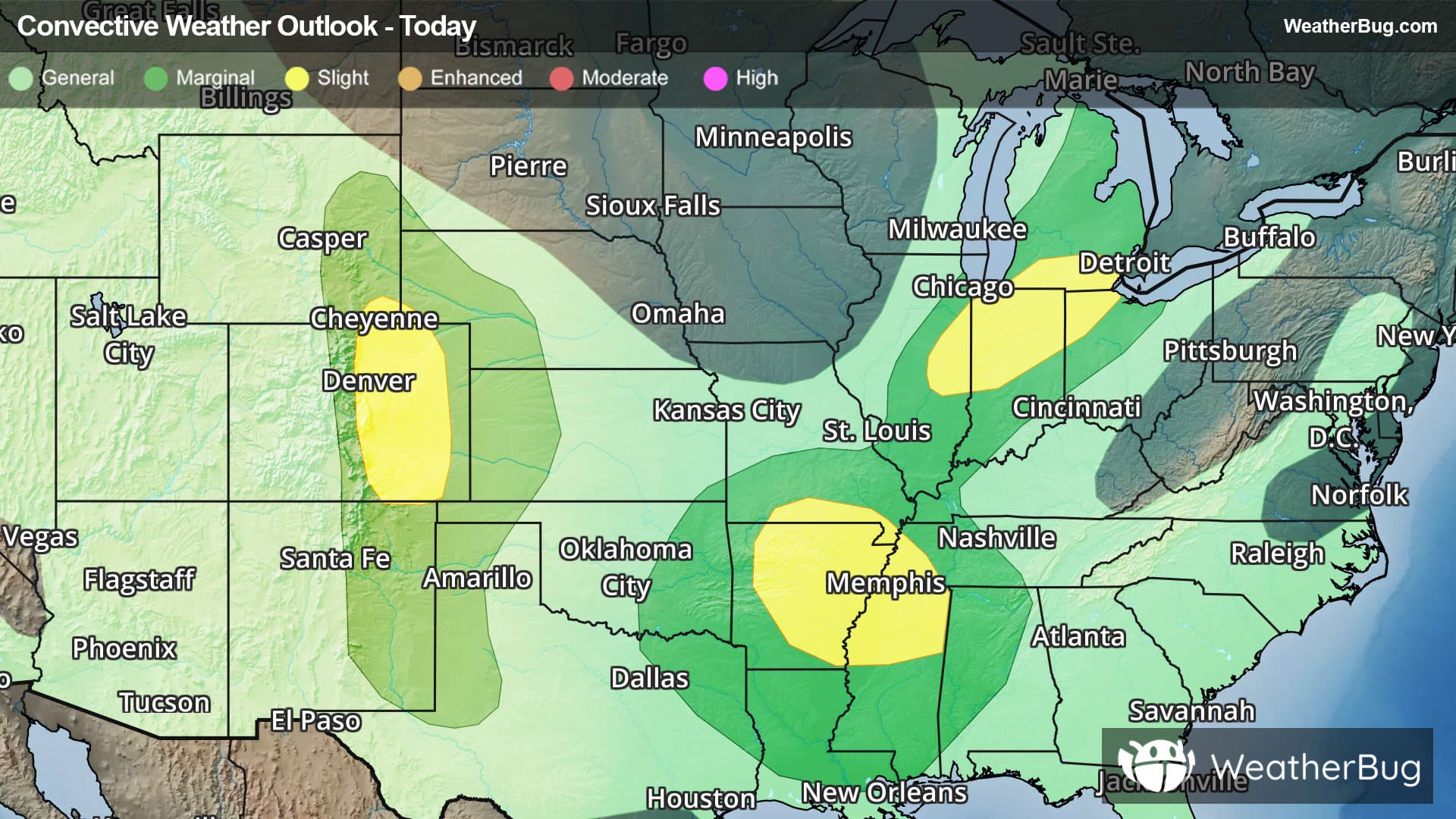
-There is a Slight Severe Storm Risk for your location. Continue reading for today's outlook from the National Weather Service's Storm Prediction Center. -------------------- National Severe Storm Outlook THERE IS A SLIGHT RISK OF SEVERE THUNDERSTORMS PORTIONS OF THE NORTHERN PLAINS AND UPPER MIDWEST SUMMARY Severe thunderstorms are possible from parts of the northern Plains into the Upper Midwest today. Large hail and severe winds are the primary concerns, though a couple of tornadoes may also occur. Synopsis A shortwave trough will advance eastward from the northern Rockies into the northern Plains today. At the surface, a low will move northward out of Nebraska into the Dakotas, with a cold front/dry line extending southward to a secondary low across the central Plains. Thunderstorm activity is likely to be ongoing at the start of the period near the northern surface low across portions of the Dakotas. Additional thunderstorm activity is expected in the wake of the morning convection near the warm front lifting across North Dakota into Minnesota and near the cold front back into portions of the Mid-Missouri Valley and central Plains. Dakotas/Mid-Missouri Valley/Upper Midwest Elevated supercell activity is likely to be ongoing at the start of the period across portions of the Dakotas near the surface low and nose of the low-level jet axis. The environment will be characterized by moderate to strong instability and strong deep layer shear. Guidance suggests that this will have the potential to produce large to very large hail and damaging wind. As the low develops, a warm front will extend into North Dakota/Minnesota by the afternoon. Evolution of the morning activity remains uncertain, but it appears that additional storms will develop near the warm front and back near the low/cold front into the afternoon. Near the warm front, filtered heating through broken low to mid-level cloud cover will allow for moderate instability by the afternoon. A plume of steep low to mid-level lapse rates will advect northward through the afternoon. The favorable thermodynamic profiles and strong deep layer shear around 45-50 kts will support potential for supercells. If these storms can become surface based, they will be capable of all hazards. Back west near the cold front/low, initial supercells are possible by the afternoon. These will have potential primarily for large hail and damaging wind. Boundary parallel deep-layer shear will likely lead to clustering/upscale growth with time. Strong to extreme instability is expected ahead of the cold front across portions of the western Dakotas into the Midwest. As the low-level jet increases into the evening, it is possible that a corridor of more favorable damaging wind potential (including significant gusts 75+ mph) may evolve. For now, confidence in convective evolution is low with a few CAMs suppressing convection towards the evening along the front amid the strong EML until later in the evening around 06z. Kansas/Oklahoma/Texas Isolated high-based thunderstorms are possible near the dryline in Kansas/Oklahoma/Texas. Moderate instability is expected within this region with generally weak deep layer shear. This will likely keep more widespread severe potential low. However, a few stronger storms may be capable of strong winds given deeply mixed profiles. For now, this potential remains too isolated to include probabilities.